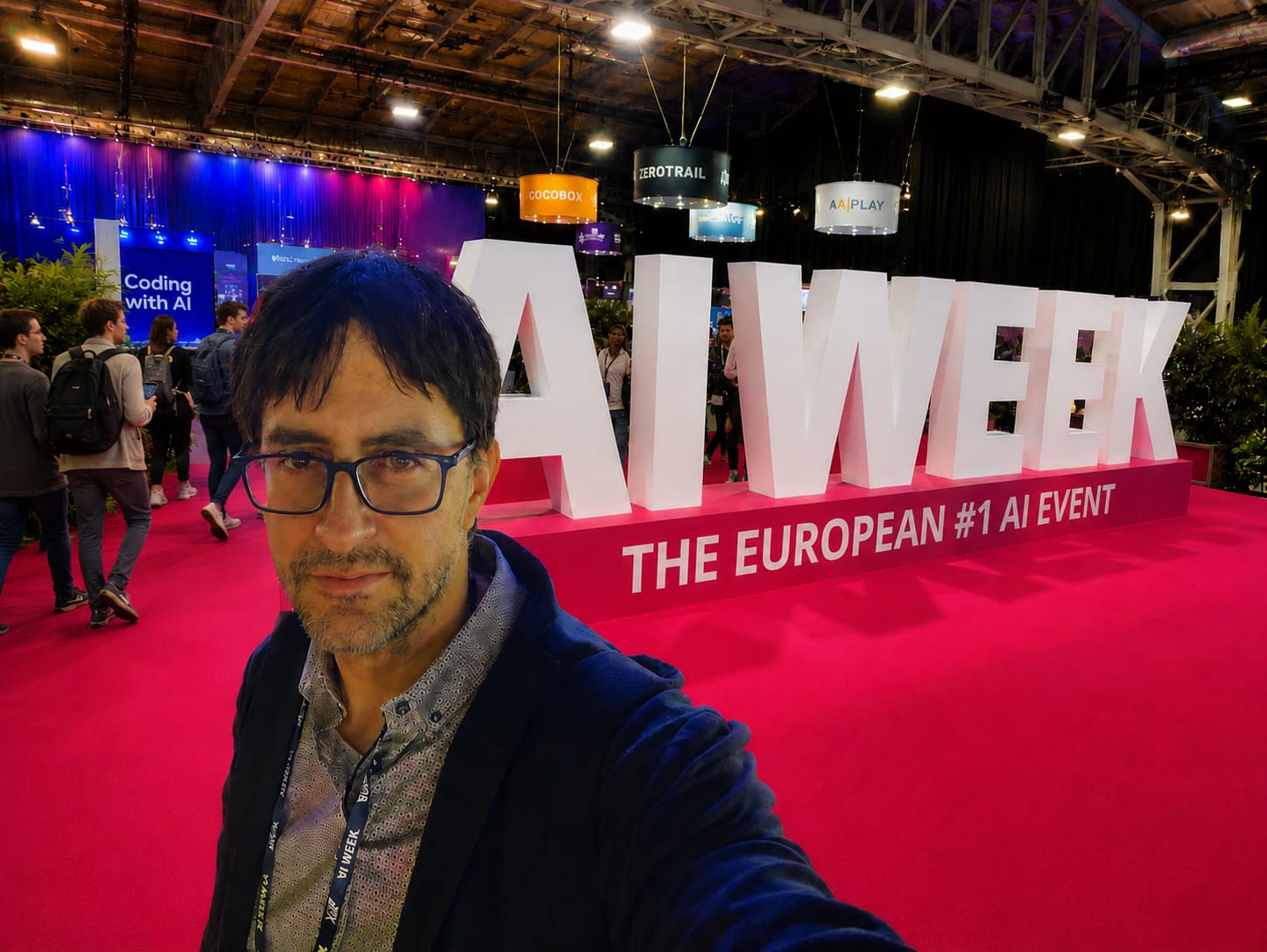
I went to Milano AI Week 2026 expecting demos. I came back with observations — about the technology, the people, and a few small things I didn't expect to remember.
The event is positioned as Europe's biggest AI gathering. After two days inside it, I think the more accurate description is: a cross-section of where AI actually is in 2026. Some of it impressive. Some of it predictable. A few moments unexpectedly good. And some details that have nothing to do with AI but that I keep thinking about anyway.
Here are the things I'm taking home.
The women in AI stage
One of the stages was dedicated to women working in AI. The presenters were all women — founders, researchers, engineers, leaders — and the explicit intention was to inspire other women, younger and older, to get involved in the field.
What struck me wasn't the content (which was strong) but the atmosphere. The energy in the room was warmer than a typical conference panel — and by the end of one session, presenters and audience were taking a group selfie together. That's not something I see at most tech events.
I have two daughters — one is ten, the other seventeen. Watching that stage, I kept thinking about them. Not about whether they should "become AI engineers" — that's the wrong framing. About whether they'll be AI-native and IT-native regardless of which career they choose. That capability, layered on top of whatever they end up doing, is a permanent advantage.
The translation I didn't know existed
I heard most talks directly in Italian — I understand it well enough. But occasionally I switched the smart headphones available on each seat to English to see what the AI translation sounded like.
I knew real-time AI translation existed in principle. I didn't know it had crossed the line into being genuinely usable. The latency was three to five seconds. The voice sounded a little AI-generated in stretches, but the meaning was preserved cleanly. It was fluid enough that you could follow a complex argument without having to mentally pause to reconstruct.
Three years ago this would have been a demo. Now it's just infrastructure at a conference. I keep noticing this pattern: capabilities that felt aspirational in 2023 are now being quietly installed in the background of events. Most attendees probably didn't think about it twice. That, in itself, says something.
Three observations I'm still thinking about
The substantive content of the event reinforced three ideas that I want to come back to in writing later. I'll mention them here briefly without doing them justice.
First, the agentic AI gap is real. Enterprise data presented at the event showed 59% of organizations using agentic AI but only 9% with successful autonomous workflows. The space between marketing adoption and operational adoption is wider than most companies want to admit.
Second, AI belongs in the data, not in the process. One speaker put it cleanly: AI accelerates data understanding and tool creation, but workflows that need to run the same way twice should be code, not agents. This is the architectural conversation that's missing from most AI implementations I see in the wild.
Third, knowledge bases are more than chunks and vectors. The real intelligence in a knowledge base lives in the relationships between segments — which is exactly what most "RAG implementations" stop short of. The vector layer is the floor, not the ceiling.
The RAG consulting engagement covers source citations, permission boundaries and evaluation before handover.
The robot everyone watched
In one of the exhibition halls there was a humanoid robot. It picked things up, set them down, repeatedly. It was a robot designed for factory floors. I didn't catch the company name.
What I caught was the crowd. A constant rotation of people stopping to watch. Phones out, recording. Some standing for several minutes. It wasn't doing anything dramatic — just picking things up and setting them down. But people kept stopping. None of the screens around it had that effect.
There's something honest about that. We've been told for years that AI is changing everything, and most of it lives invisibly inside models and APIs. A robot picking up a box is the version you can actually see. It's no surprise that it commanded the most attention.
The Cybertruck nobody could ignore
In another corner, a Cybertruck. Static. Not doing anything. Just parked, looking exactly like a Cybertruck.
Constant queue of people taking photos with it.
It was presumably there because of the AI inside it — autopilot, FSD, the whole stack. But that's not what people were photographing. They were photographing the truck. The car was the spectacle. The AI was just the excuse.
I'm not sure what conclusion to draw from this, except: the things that get attention at an AI event are not always the AI things. Sometimes they're cars. Sometimes they're coffee queues.
The coffee situation
There was one food court inside. Three food stands outside. For thousands of attendees.
Between 12:30 and 2pm, the queues were absurd. Getting a coffee was a thirty-minute commitment. Getting lunch was an exercise in strategic patience. By the second day I had given up and was budgeting twenty minutes into my schedule specifically for caffeine.
I mention this not to complain — though I am, slightly — but because by then I had a theory I was sharing with anyone willing to wait in line with me: organizers should handle two things first — WiFi and food. Everything else is optional.
It got laughs. It also kept getting nods.
The missing WiFi
Which brings me to the second half of my coffee-line theory.
The event provided no WiFi. Two days of mobile data.
For an AI conference in 2026 — where most demos, networking, and content sharing happen online — that's a choice. I'm not saying it was the wrong choice. I'm just saying my mobile carrier had a very good two days.
A perk that would have been worth more than a tote bag.
What I'm taking home
Two days, thousands of attendees, one humanoid robot, one Cybertruck, real-time AI translation, a Women in AI stage that felt different from the rest, and a few ideas I'll be writing about for the next several months.
The most interesting parts of an event are rarely the ones on the agenda. They're the conversations between sessions, the things you notice in the exhibition halls, the stages you wander into by accident. The Women in AI stage was the most genuine room I walked into. The translation headphones were the most quietly impressive technology. The robot was the most-photographed object. The coffee line was the most unifying experience.
Not a bad two days.